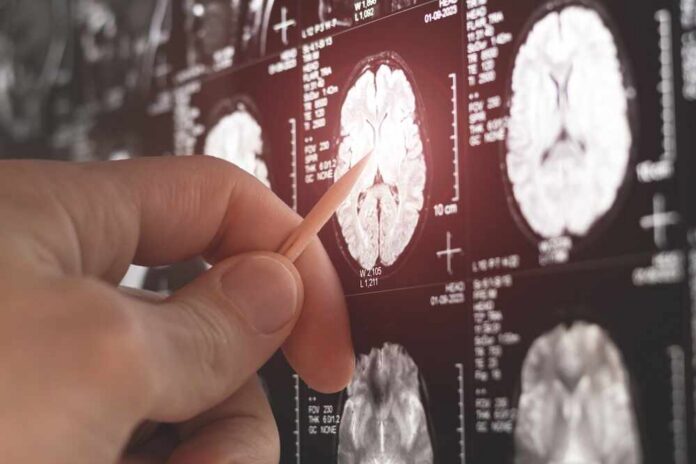
Your brain’s hidden clock is now ticking visibly on a single MRI scan, revealing if dementia lurks years ahead.
Story Snapshot
- AI tools from Duke and USC measure brain aging speed from routine MRI scans, predicting cognitive decline before symptoms hit.
- DunedinPACNI analyzes 315 brain structures to forecast dementia, frailty, and mortality in midlife adults.
- USC’s 3D-CNN model tracks changes over time, correlating directly with cognitive test declines in healthy and Alzheimer’s patients.
- Saliency maps highlight exact brain regions driving aging rates, varying by age and sex for precise insights.
- Shift to proactive health: intervene with lifestyle changes while still sharp, not after memory fades.
Duke’s DunedinPACNI Measures Midlife Brain Pace
Duke University researchers trained DunedinPACNI on 860 MRI scans from 45-year-olds in the Dunedin Study. This tool processes 315 structural brain measures to compute aging rates from one scan. Applied to tens of thousands across studies, it predicts cognitive impairment, rapid atrophy, dementia diagnosis, physical frailty, poor health, future diseases, and mortality. Midlife data forecasts outcomes decades later, empowering early action. Dr. Ahmad Hariri notes it captures aging speed in midlife to predict later dementia.
USC’s 3D-CNN Tracks Longitudinal Brain Changes
USC team led by Andrei Irimia and Paul Bogdan developed a 3D convolutional neural network. This model compares baseline and follow-up MRIs for true pace-of-aging data, unlike static snapshots. Tested on 104 healthy adults and 140 Alzheimer’s patients, brain aging speeds matched cognitive function changes precisely. Dr. Irimia states this novel metric could transform lab and clinic brain health tracking. Knowing your pace proves powerful for prevention.
Saliency Maps Reveal Actionable Brain Insights
Both tools produce saliency maps pinpointing brain regions influencing aging assessments. Regions vary by age and sex: red areas dominate in 70-year-olds, blue in 50-year-olds. This interpretability overcomes black-box AI limits, aiding clinical trust and biological understanding. Maps show pathological acceleration versus normal aging, guiding targeted interventions. Experts confirm alignment with cognitive tests validates these as true biomarkers, not artifacts.
From Research Labs to Your Doctor’s Office
Validation complete, tools transition to clinics. Healthcare integrates assessments into neurology checks for at-risk groups. Midlife adults gain warnings for lifestyle tweaks like diet, exercise, cognitive training. Pharmaceutical firms target high-risk trial recruits, speeding drugs. Older adults and family-history cases receive personalized risks. Systems build protocols; researchers standardize biomarkers. Short-term: faster studies; long-term: prevention-focused care like cholesterol monitoring.
Proactive Steps Beat Reactive Decline
Midlife MRIs flag fast agers for interventions in prime windows. Older adults spot dementia risks pre-symptoms, maximizing training and meds. At-risk families ditch generic odds for tailored plans. Brain aging signals systemic issues, modifiable via habits aligning with self-reliance values. Evidence shows pace correlates with frailty and death, but lifestyle holds promise despite emerging data gaps. Complement with cognitive tests for full picture. Public health targets disparities; ethics watch insurance misuse.
Sources:
USC Leonard Davis School of Gerontology: New AI model measures how fast the brain ages
PNAS: Proceedings of the National Academy of Sciences
NIH Research Matters: Measuring aging with brain scans
Duke Today: Scientists can tell how fast you’re aging from a single brain scan
PMC: Multimodal brain age prediction