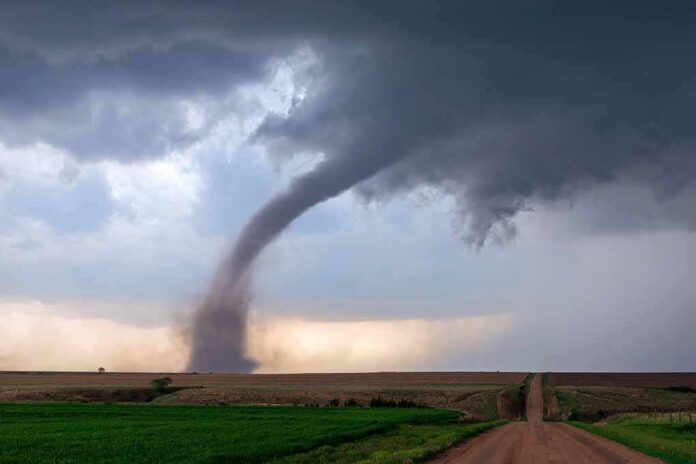
The June 17-18, 2026 Midwest tornado outbreak was not a single dramatic moment but a sustained, multi-state meteorological assault — one whose full scope took days of official storm surveys to document, even as live coverage was already shaping public perception of what had happened.
At a Glance
- The June 17-18, 2026 outbreak produced confirmed tornadoes across Illinois, Indiana, Iowa, Kentucky, Ohio, and Wisconsin, with wind gusts approaching 80 mph and hail the size of baseballs.
- A rare Level 4 out of 5 severe weather threat was issued by the Storm Prediction Center, driven by a deep low-pressure system, a strong low-level jet streak, and Significant Tornado Parameter values reaching 4-6 over central Illinois.
- The outbreak was the second major Midwest tornado event within weeks — preceded by the April 17-18 outbreak that itself produced 86 confirmed tornadoes and set records for the NWS La Crosse office.
- Research shows tornado frequency is shifting eastward and increasing in the Midwest and Southeast — making events like this less anomalous and more representative of a structural trend.
The Meteorological Setup: Why June 17 Was Exceptional
To understand why the Storm Prediction Center issued a Level 4 out of 5 severe weather threat — a designation rare enough that its issuance alone warranted national attention — you have to understand the confluence of ingredients that came together over central Illinois. The National Weather Service office in Lincoln documented the mechanism precisely: clusters of thunderstorms formed on the nose of a strong low-level jet streak across Iowa during the pre-dawn hours, then tracked southeastward along a warm frontal boundary into central Illinois through midday. [1] That combination — jet-streak forcing, frontal boundary, and daytime destabilization — is a textbook recipe for organized convection capable of producing long-track tornadoes.
What elevated this event above ordinary severe weather was the behavior of the Significant Tornado Parameter, or STP — a composite index that meteorologists use to gauge how favorable the atmosphere is for significant tornado production. By 6 p.m. on June 17, STP values over east-central Illinois had climbed to 4-6, a range associated with environments capable of producing violent tornadoes. [1] Mid-level winds were running near 100 mph aloft. [4] Ryan Hall’s live coverage noted that the driving low-pressure system was unusually deep for June, possibly near record depth for Michigan, which amplified the wind shear well beyond what a typical summer severe-weather day would provide. Storms were also moving at 60-75 mph — faster than most Midwestern outbreaks — compressing warning lead times and increasing the danger for anyone in their path.
What the Surveys Confirmed: Scope Across Six States
Official storm surveys take time, and the full picture of the June 17-18 outbreak emerged in stages. In central Illinois, the NWS Lincoln office confirmed several tornadoes, widespread damaging wind gusts up to around 80 mph, hail as large as 3 inches in diameter, and localized flash flooding. [1] The most intense supercells tracked from far eastern Sangamon County through Decatur, Arthur, and Charleston — where one tornado registered winds of 116 mph and traveled 13.8 miles. [14] Effingham, south of Interstate 70, sustained significant structural damage from a tornadic supercell that moved through after 10 p.m.
In Indiana, five tornadoes were confirmed in Owen, Monroe, and Jackson counties by the following afternoon. [9] The NWS Cincinnati office documented a separate cluster of confirmed tornadoes across southern Indiana, northern Kentucky, and southwest Ohio as the mesoscale convective system — an MCS, a large organized complex of thunderstorms — pushed into the Ohio Valley overnight. [11] That list included EF2-rated tornadoes near Aurora, Indiana; Drewersburg, Indiana; Elm Grove, Ohio; and Maysville, Kentucky, along with EF1 tornadoes near Florence and Williamstown, Kentucky. [11] Over 82,000 customers lost power across the affected states. [4] Tornadoes were also documented in Iowa and Wisconsin during the same outbreak window.
Context: A Season Already Saturated With Severe Weather
The June 17-18 event did not occur in isolation. It arrived after a spring that had already tested the Midwest repeatedly. The April 17-18, 2026 outbreak produced 86 confirmed tornadoes across the Midwestern United States, Upper Midwest, and Southern Plains. [2] The NWS La Crosse office alone issued 26 tornado warnings in a single day — the most since the office opened in 1995 — and documented 10 tornadoes, making it the largest April outbreak on record for that office, with preliminary reports of over 100 homes damaged. [3] Then, on June 11, the NWS Chicago office confirmed at least 23 tornadoes across northern and central Illinois and northwest Indiana, including an EF-3 that tracked from Long Point to Streator. [13] By the time June 17 arrived, the region had already absorbed multiple billion-dollar-class severe weather events within a single season.
That accumulation matters for how the June 17 event was perceived and covered. CNN noted that the recent storms had “compounded the difficulties faced by a region already beleaguered by severe weather,” with last week’s multi-day storm event alone generating over 1,500 reports of wind, hail, and tornado activity across the central United States. [4] A 94 mph wind gust near Albion, Iowa — hurricane-force strength — was recorded during the early morning hours of June 17 before the main tornado threat even materialized. The sheer density of events across a compressed calendar window is itself significant meteorologically: it reflects a synoptic pattern that repeatedly reloaded favorable ingredients over the same geography.
The Shifting Geography of Tornado Risk
One of the more consequential patterns embedded in this outbreak season is what it reveals about where tornado risk is concentrating in the United States. The traditional mental map — “Tornado Alley” running through Oklahoma, Kansas, and the Texas Panhandle — is increasingly outdated. Research now shows a statistically significant upward trend in tornado frequency across the Southeast, Midwest, and Northeast, with elevated risk documented specifically in Missouri, Illinois, Indiana, Tennessee, and Kentucky. [16] The Great Plains, by contrast, has seen a decrease in tornado frequency in some areas.
The practical implication is that the June 2026 outbreak season is not an anomaly to be explained away but a data point in a trend that emergency managers, insurers, and residents of the Midwest and Ohio Valley need to internalize. The NWS La Crosse office’s “largest April outbreak on record” and the NWS Chicago office’s 23-tornado June 11 event are not flukes — they fit a pattern of increasing tornado concentration on fewer, more intense outbreak days. The infrastructure, warning systems, and public preparedness frameworks built around the old Tornado Alley geography are increasingly misaligned with where the risk actually lives.
Sources:
[1] YouTube – Tornadoes rip through Midwest as high winds fuel wildfires in West
[2] Web – June 17, 2026 Severe Weather
[3] Web – Tornado outbreak of April 17–18, 2026 – Wikipedia
[4] Web – The Tornado Outbreak of April 17 2026 – National Weather Service
[9] YouTube – The June 17-18, 2026 Tornado Outbreak Coverage, As It Happened…
[11] Web – After Tornadoes, Towns in Wisconsin and Illinois Turn to Cleanup
[13] Web – June 18, 2026 Tornadoes, Wind, and Flooding
[14] Web – June 11, 2026: Tornado Outbreak, Including Multiple Strong …
[15] Web – We are up to 5 confirmed tornadoes from the event Wednesday …
[16] Web – Classifying synoptic patterns driving tornadic storms and associated …
[24] Web – High-Impact Weather and Climate Events | Western Water Assessment