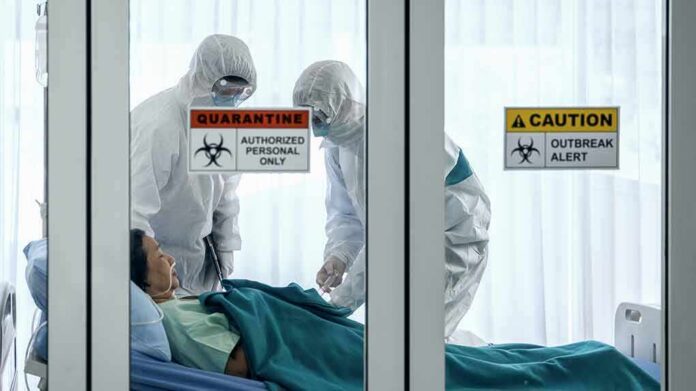
The most dangerous thing inside eastern Congo’s Ebola zone is not the virus itself, but how far it can run before the world decides to get serious.
Story Snapshot
- Ebola caused by the Bundibugyo strain is spreading across eastern Democratic Republic of the Congo and into Uganda with no approved vaccine or treatment in hand.
- World Health Organization (WHO) has declared a Public Health Emergency of International Concern, but the virus is still outpacing field operations.
- Weak health systems, conflict, and community mistrust are turning a containable outbreak into a rolling fire.
- The real test is whether governments and donors move from press conferences to practical, boots-on-the-ground support.
Inside the emergency: a virus with a head start
World Health Organization officials determined in mid‑May that the Bundibugyo‑strain Ebola epidemic in the Democratic Republic of the Congo and Uganda met the threshold for a Public Health Emergency of International Concern, the highest alarm the agency can ring under international health rules.[3] That decision came as suspected and confirmed cases climbed into the hundreds, with at least 80 deaths recorded by May 16 alone.[4] Those numbers are not abstract; they signal a virus already several steps ahead of the response lines.
Unlike the West African outbreak a decade ago, this time there is no licensed vaccine or approved therapeutic tailored to Bundibugyo virus disease, so responders lean entirely on classic tools: isolation, contact tracing, safe burials, and supportive care to keep patients alive.[3][4] That “old‑school” approach can work, but only if teams move faster than chains of transmission. Every missed contact, every delayed ambulance run, becomes a new cluster three weeks later.
Why this Ebola strain is so hard to stop
The Bundibugyo strain complicates everything because its biology is familiar but our countermeasures are not ready for prime time.[3] Health workers cannot roll out mass vaccination rings like they did with other Ebola strains in past Congolese outbreaks. That forces a labor‑intensive model: tracking every exposure, persuading frightened families to cooperate, and keeping already‑fragile rural clinics functioning while staff risk their lives daily. When that model runs into real‑world limits, the virus simply slips through the cracks.
This outbreak is not unfolding in a vacuum; it sits on top of armed conflict, displaced populations, and informal cross‑border trade routes that pay no attention to disease control maps.[3][4] Frequent movement between eastern Congo and western Uganda means a case that looks “local” today might seed infections hundreds of miles away within days. Public health workers are effectively trying to build a firebreak in dry brush while armed groups and economic necessity keep blowing sparks over their line.
The response: racing with lead weights on
World Health Organization communications emphasize that response strategies now rely heavily on intensive public health measures and rapid scale‑up of field capacity.[3] United States health authorities, through their emergency alerts, confirm that hundreds of suspected cases and dozens of deaths have already been logged in remote areas, underscoring how stretched surveillance and laboratory systems are.[4] Officials have mobilized teams, supplies, and coordination cells, but scaling logistics into insecure, road‑poor terrain takes more than a few high‑profile visits.
Independent and humanitarian reports from prior Congo outbreaks show a recurring pattern that appears again here: community fear and disinformation spread almost as quickly as the virus.[2] Rumors that Ebola treatment centers are places “you go to die” or that responders are profiting off suffering can lead families to hide sick relatives, attack burial teams, or flee into the bush.
Is the response too slow, or are expectations unrealistic?
News segments and social clips now frame the outbreak as “outpacing” the response, suggesting officials and aid groups are behind the curve.[1] The hard data supports one half of that sentence: the epidemic is expanding in geographic reach and in case counts despite the formal emergency declaration.[3][4] What the public record does not yet show is full operational performance detail—how many contacts traced per case, how many safe burials completed, how many communities refusing entry—which would prove or disprove claims of outright failure.
🚨🩺 Ebola Crisis Deepens in DR Congo 🚨
WHO chief warns the outbreak is outpacing response efforts with nearly 1,000 suspected cases. No approved treatment for this strain as aid arrives.
Source: PBS News#Ebola #DRCongo #WHO #GlobalHealth #Outbreak
— DailyNews (@indiadailybot) May 31, 2026
Given decades of Ebola experience in Congo, the more grounded interpretation is sobering but not sensational: the response is running hard, but structural realities are running harder. Health systems that never functioned well under normal conditions now face a hemorrhagic fever with no tailored vaccine. Insecurity and displacement turn what should be short supply runs into multi‑day risks. From a taxpayer‑minded angle, that raises the real question: are we investing in fixing these fundamentals, or just paying for the next emergency headline?
Sources:
[1] Web – Inside Ebola Epicenter, Virus Rages With Little to Stop It…
[2] Web – Ongoing outbreak in the Democratic Republic of the Congo | WHO
[3] Web – Ebola in the Democratic Republic of the Congo – ICRC Newsroom
[4] Web – The Democratic Republic of the Congo Ebola Outbreak