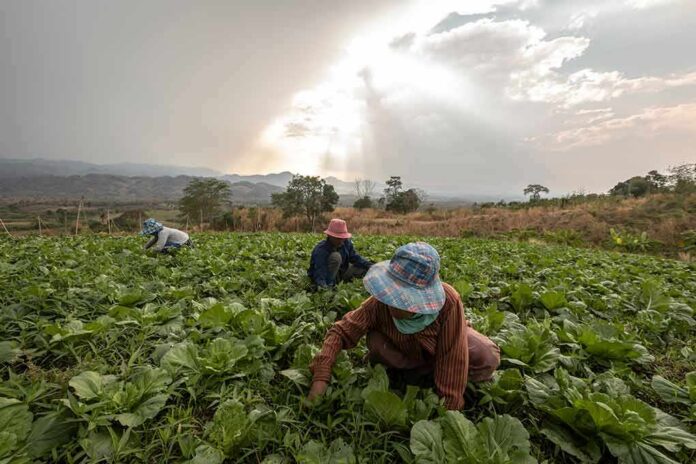
For the first time ever, Africa now has more people going hungry than any other continent, even as the rest of the world slowly pulls back from the brink.
Story Snapshot
- Africa’s hunger rate passed 20% in 2024, hitting about 307 million people.
- United Nations projections say nearly 60% of the world’s hungry could live in Africa by 2030.
- Conflict, climate shocks, weak economies, and high food prices are driving the crisis.
Africa Becomes Hunger’s Global Epicenter
A United Nations report released in 2025 confirmed a historic and grim milestone: Africa now has the highest share of its people facing hunger of any region on Earth. More than one in five Africans were chronically undernourished in 2024, roughly 307 million people. While parts of Asia and Latin America are slowly improving, hunger in Africa is doing the opposite. It is rising, and spreading, even as global numbers finally inch downward.
Global agencies like the World Health Organization, the United Nations Food and Agriculture Organization, and the World Food Programme stress that this is not a short-term shock. It is the product of years of overlapping crises: wars that never end, crops ruined by drought and floods, governments weighed down by debt, and food prices that stay high long after headlines move on. For many African families, these forces stack on top of each other, turning simple setbacks into life-threatening hunger.
Why Hunger Falls Globally But Rises In Africa
The same United Nations report shows a mixed global picture. Worldwide, about 8.2% of people faced hunger in 2024, down from previous years. Asia, South America, and parts of the Middle East saw modest improvement. Africa stands out as the exception. Sub-Saharan Africa now has the highest rate of undernourishment and food insecurity of any region, with more than two-thirds of people struggling to get enough food. That contrast is at the heart of this story: progress for some, deep crisis for Africa.
The reasons line up closely with what common sense and conservative values would expect when basic order breaks down. Conflict destroys farms and roads, making markets unsafe and aid deliveries risky. Weak or corrupt governance fails to protect rural producers or plan grain reserves. Inflation and debt crowd out investment in seeds, irrigation, and storage. When leaders cannot secure borders, enforce contracts, or keep currencies stable, families pay the price at the dinner table first.
The Numbers Behind A Growing Disaster
United Nations data now place Africa’s hunger prevalence above 20%, compared with just over 8% in Asia. Regional briefs estimate Africa’s 2025 Global Hunger Index score at 25.1, rated “serious,” with Sub-Saharan Africa driving that high level through extreme undernourishment and child deaths. These are not just statistics; they signal a continent where millions of children start life stunted, where farmers eat seed instead of planting it, and where any shock can tip whole regions toward famine.
Looking ahead, the numbers grow even more stark. United Nations projections suggest that by 2030, nearly 60% of the world’s chronically undernourished people will live in Africa. That would mean hundreds of millions of people trapped in long-term hunger, not just short-term emergencies. The warning is clear: if current trends continue, Africa will carry most of the world’s hunger burden, even as other continents slowly move forward.
Drivers Of Hunger: Conflict, Climate, And Broken Food Systems
Reports from the Global Hunger Index and other researchers point to a cocktail of drivers that together block progress in Africa. Violent conflict remains the single strongest force in many countries, forcing farmers off their land and cutting off trade routes. Climate change brings longer droughts and harsher floods, hitting rain-fed farms that lack irrigation or insurance. Economic instability and high food prices make it even harder for families to afford a healthy diet, especially in cities.
Analysts also point to deeper structural issues that get less attention. Corporate control of seed, fertilizer, and retail in some countries drives prices up and locks small farmers into one-sided deals. Colonial-era food systems, built for export crops, left many regions dependent on imported staples instead of diverse local foods. When global media frame Africa’s hunger as “natural” or purely climate-driven, they skip these man-made systems that keep people poor and hungry. That silence weakens pressure for real reform.
What This Means For Policy, Aid, And Accountability
United Nations agencies warn that without major changes, the world will miss its Zero Hunger target for 2030, and Africa will bear most of that failure. From a conservative, common-sense view, the path forward starts with basic security and sound governance. Wars must end, property rights must be protected, and markets must work so farmers can sell food at fair prices. Foreign aid helps in emergencies, but it cannot replace local responsibility or long-term investment.
The deeper question is whether global leaders will treat Africa’s hunger crisis as a passing headline or a test of their stated values. The data are no longer in doubt: hunger is falling in much of the world and rising across Africa. The choice now is whether to face the hard causes—conflict, broken systems, and weak leadership—or keep blaming “shocks” while millions go to bed hungry, night after night.
Sources:
insiderpaper.com, who.int, paulndiho.com, reuters.com, globalhungerindex.org, un.org, ssa.foodsecurityportal.org, sipri.org, africacenter.org, borgenproject.org, fao.org, disasterphilanthropy.org, theconversation.com, compassion.com, ourworldindata.org