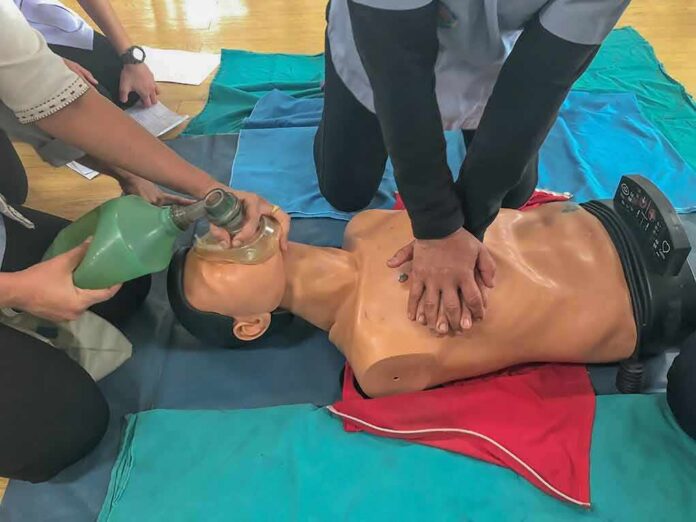
A stranger’s two hands, pushing hard and fast on a chest, can double or even triple a cardiac arrest victim’s chance of survival before paramedics ever show up.
Quick Take
- Hands-Only CPR skips rescue breaths and focuses only on chest compressions.
- The American Red Cross says anyone, trained or not, can learn it in about 30 minutes.
- The technique works because it removes the biggest reason bystanders freeze up: fear of mouth-to-mouth contact.
- Doctors say it can be just as effective as full CPR in the first few minutes after a sudden collapse.
What Hands-Only CPR Actually Looks Like In An Emergency
When someone collapses and stops responding, the first move is to check the scene for danger, then check the person. Tap their shoulder and shout to see if they wake up. If they don’t respond and aren’t breathing normally, call 911 right away or get someone nearby to call while you start helping.
Once help is on the way, get the person flat on their back on a hard surface. Kneel beside them, place the heel of one hand in the center of their chest, and lock your other hand on top. Push hard and fast, at a steady pace of 100 to 120 pushes per minute, and keep going until paramedics take over or an automated defibrillator arrives.
There’s no need to count breaths or tilt the head back for mouth-to-mouth. The whole method boils down to two steps: call for help, then push on the chest without stopping. That simplicity is the entire point, and it’s why the Red Cross markets this version to people who have never taken a single first-aid class in their lives.
Why Doctors Stripped Rescue Breaths Out Of The Equation
CPR training used to mean memorizing breath counts, head tilts, and compression ratios that intimidated plenty of willing bystanders into doing nothing at all. The American Heart Association broke from that script in 2008, officially endorsing a stripped-down version built around calling 911 and pushing hard on the chest until help arrived.
That shift mattered because hesitation kills. Only about one in four people who suffer cardiac arrest outside a hospital gets any bystander help at all before professionals arrive, and every minute without compressions chips away at survival odds. Removing the mouth-to-mouth step gave more people the confidence to jump in immediately instead of standing frozen, waiting for someone more qualified.
Research backs up the simplified approach. Multiple studies comparing compression-only CPR to traditional CPR with rescue breaths found similar survival rates among adults treated by everyday bystanders, not medical professionals, in the critical early minutes after collapse. The Red Cross and the American Heart Association both now treat Hands-Only CPR as a legitimate, standalone response, not a watered-down backup plan.
Where To Learn It And Why It’s Worth Thirty Minutes
Local Red Cross chapters run short community sessions, often around 30 minutes, teaching the full sequence of checking, calling, and compressing. These sessions don’t hand out certification cards, but that’s not the goal. The goal is muscle memory, so when a real emergency hits, your hands already know what to do.
Medical guidance is blunt about who this method is for. MedlinePlus puts it simply: if you haven’t had CPR training, you can still perform hands-only compressions on a teen or adult whose heart has stopped. Put your phone on speaker, call 911 immediately, and let the dispatcher walk you through it step by step while you keep pushing.
The broader lesson here fits common sense more than it fits any medical mystery. A simple instruction that regular people will actually follow beats a perfect protocol that scares them into doing nothing. That’s a principle worth applying well beyond emergency medicine, and it’s exactly why this method keeps spreading through fire departments, sports leagues, and community centers across the country.
Sources:
redcross.org, olis.oregonlegislature.gov, redcross.org.hk