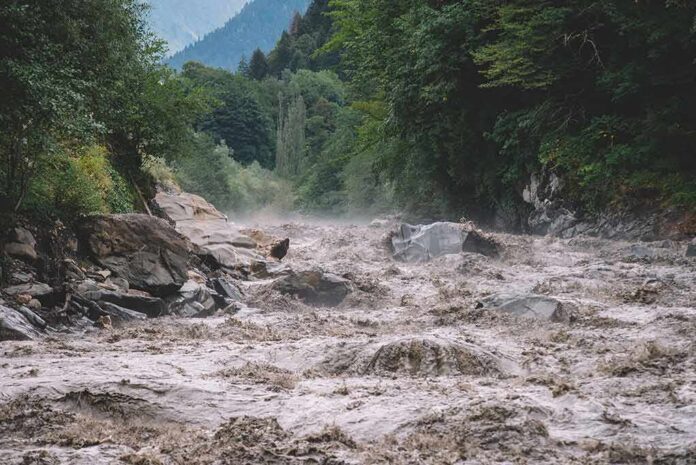
A wall of water tore through Nepal’s high border valleys and left rescue teams racing time, terrain, and rising fear.
Story Snapshot
- At least 95 people were confirmed dead and hundreds were missing after flash floods near Nepal’s border with Tibet.
- Nepal’s leader pledged full government responsibility for rescue, treatment, food, and shelter.
- Police and army units launched helicopter and ground rescues; injured patients were airlifted to Kathmandu, according to reports.
- Hospitals in the capital set aside surge beds and mobilized relief supplies, officials said through media reports.
Floods Rip Through Border Valleys, Leave Hundreds Unaccounted For
Flash floods struck steep river corridors near the Nepal–Tibet border on August 26, sweeping away homes, bridges, and work sites. Police reported at least 95 bodies recovered, and news outlets cited hundreds still missing as the search widened. Torrents roared down narrow gorges that give little warning and few escape routes. Rescue crews faced broken roads, unstable slopes, and fast currents that blocked heavy vehicles. Helicopters became lifelines for scouting, supply drops, and medical evacuations.
Local stations showed rescuers crossing buckled spans and bulldozers carving paths to stranded clusters. Command posts formed along the Bhotekoshi corridor and other hit valleys. The first wave focused on pulling survivors from rooftops and river islands and moving the injured to higher ground. Radio relays and satellite phones carried coordinates to flight crews. Nightfall forced pauses, but lights stayed on at forward clinics as teams treated shock, fractures, and hypothermia.
Government Pledge: “We Take Full Responsibility”
Nepal’s leader told citizens to stay patient and united, saying the government takes full responsibility for rescue, treatment, food, and shelter. The statement matched the on-the-ground mobilization already visible in the first hours. Police and army units fanned out with boats, ropes, and excavation gear, while military helicopters ferried teams and relief loads into cut-off pockets. Reports said injured survivors were flown to Kathmandu for care as triage hubs filled near the impact zone.
Officials also convened Nepal’s disaster authority to tighten coordination with medical teams, scouts, and the Red Cross, according to international reporting from the capital. That structure fits Nepal’s playbook for fast-moving floods: central direction, local execution, and heavy reliance on airlift when roads fail. Early numbers stayed fluid as missing-person lists grew and shrank by the hour. Newsrooms cited different tallies as field units verified names and moved through debris.
Hospitals, Shelter, And Supplies Move Into Position
Media reports said Kathmandu’s Bir Hospital and the National Trauma Centre set aside about 100 beds for incoming patients, with more capacity on standby if needed. Health teams stocked saline, antibiotics, and splints to manage crush injuries and waterborne disease risks. The government pledged food, clean water, medicines, and temporary shelter for displaced families, which often means tarps, blankets, and hygiene kits staged at schools and ward offices. Relief lines also began moving cooking gas, dry rations, and water purification tablets toward the worst-hit valleys.
Volunteer networks filled gaps with local knowledge. Community groups flagged elder households, pregnancy cases, and people needing regular medicine. That simple step saves lives in the first 48 hours. Helicopter crews prioritized the most remote hamlets and ferried out patients who could not stand another night in wet cold. Police worked riverside grids to recover the dead with dignity and to reduce downstream hazards from debris jams.
Why Flash Floods Turn Deadly So Fast In Nepal
Steep slopes, tight canyons, and sudden cloudbursts give flash floods their lethal edge. Water can rise in minutes, not hours, and escape routes are few. Rescue math gets harsh: crews must cover long distances, often on foot, while the clock runs against trapped survivors. Global studies point to those traits as standard for severe flash floods, and Nepal’s terrain amplifies every one of them. That is why helicopters, pre-staged gear, and clear command lines matter from the first alert.
Officials and reporters agreed on the core picture: a mass-casualty disaster, an urgent state-led response, and a fast-changing count of the missing. Conservative common sense says measure leaders by actions that match promises. On day one, the pledge of full responsibility aligned with what cameras, crews, and patients in transit showed on the ground. The next test will be steady logistics: keep the lifts flying, keep the beds staffed, and keep families fed until rivers fall and roads reopen.
Sources:
insiderpaper.com, reuters.com, thehindu.com, geo.tv, ndtv.com, aljazeera.com