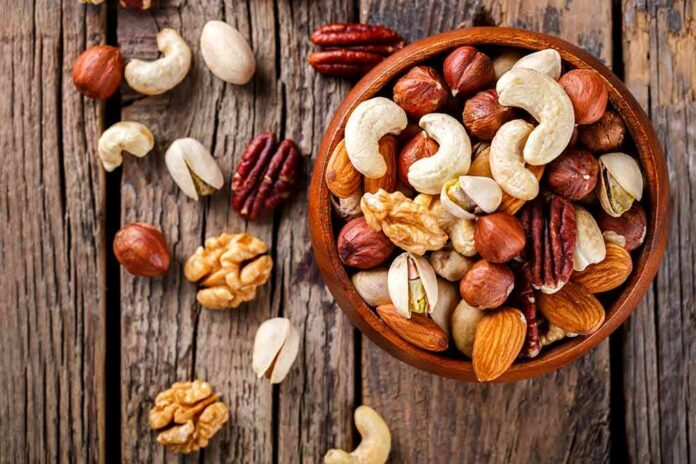
A massive review of more than one hundred clinical trials found that eating nuts every day does not pack on pounds, and may even trim body fat while improving cholesterol numbers.
Quick Take
- A review of 119 randomized controlled trials found nut eaters showed no rise in body weight, BMI, or waist size.
- Regular nut consumption was tied to a small drop in body fat, roughly 0.41 kilograms on average.
- Total cholesterol and LDL, the “bad” cholesterol, both fell slightly in nut eaters, though HDL stayed flat.
- Researchers caution the changes are modest and do not prove nuts prevent heart attacks or strokes.
A Massive Trial Review Challenges the Calorie-Fear Myth
Nuts carry a reputation as a diet-buster, loaded with fat and calories that seem destined to end up on the hips. A systematic review published in the journal Foods put that fear to the test. Researchers combed through 154 articles covering 119 unique randomized controlled trials, with 102 of them feeding into a formal statistical analysis. That is one of the largest evidence pools ever assembled on this question.
The results surprised nobody who has watched Mediterranean diet research pile up for decades, but they should still turn heads. Participants who added nuts to their daily meals took in roughly 120 extra calories a day, yet showed no measurable increase in body mass, BMI, or waist circumference. In plain terms, the math of “more calories in equals more fat on” did not play out the way common sense might predict.
Body Fat Dropped Slightly, Not Dramatically
The review found something even more notable than a lack of weight gain. Nut eaters showed a small but real reduction in body fat, an average of about 0.41 kilograms, with body-fat percentage dropping roughly three-tenths of a point. Lean-mass percentage ticked up too, though actual muscle mass did not significantly change, meaning the shift reflects body composition rebalancing rather than new muscle growth.
These numbers are not headline-grabbing in isolation. Losing less than half a kilogram of fat will not replace a gym membership or a disciplined diet plan. But across a population eating nuts as part of normal meals, consistently landing on the side of less fat rather than more fat, with zero weight penalty, is a meaningful signal worth taking seriously rather than dismissing as noise.
Cholesterol Numbers Moved in the Right Direction
Lipid results told a similarly encouraging story. Both monounsaturated-fat-rich nuts, like almonds and macadamias, and polyunsaturated-fat-rich nuts, like walnuts, were linked to reductions in total cholesterol and LDL cholesterol in the Foods review. A separate review covering 139 studies on tree nuts and peanuts backed this up, reporting significant decreases in LDL, total cholesterol, triglycerides, and apolipoprotein B, a marker tied to artery-clogging particles.
Not every lipid marker improved. HDL cholesterol, often called the “good” cholesterol, showed no significant change across the reviewed trials. That matters because sweeping claims about nuts “fixing” cholesterol need a qualifier: the benefit shows up specifically in LDL and total cholesterol, not across the board. Precision here protects the finding from getting oversold by enthusiastic headline writers.
What the Evidence Does Not Yet Prove
None of these findings confirm that eating a handful of almonds each day will prevent a heart attack or add years to anyone’s life. The trials measured blood markers and body composition, not hospital admissions or death rates. Earlier research involving nearly 5,900 participants across 86 trials similarly found no weight penalty from nuts, reinforcing the pattern without proving a direct line to fewer cardiovascular events.
Results also varied by nut type and by how nuts fit into someone’s overall diet. Swapping chips for walnuts looks different than simply piling nuts on top of an unchanged menu. The review’s authors were careful not to claim one nut variety beats another outright, and some outcomes, including triglyceride changes, were rated as carrying real statistical uncertainty.
A Reasonable Takeaway for the Dinner Table
For readers who have spent years avoiding nuts out of calorie anxiety, this body of research offers genuine reassurance grounded in rigorous, randomized trial data rather than loose observational guesswork. The sensible conclusion sits between two extremes: nuts are not a weight-loss miracle, but fear of nuts causing weight gain appears unsupported by the best available evidence.
Common sense and decades of dietary guidance already pointed toward nuts as a smart snack choice in moderation. This review adds weight, or rather removes weight-gain fears, from that recommendation. Pair a modest daily serving with an otherwise sound diet, and the data suggests you are doing your cholesterol and your waistline a quiet favor.
Sources:
youtube.com, mdpi.com, medicaldialogues.in, pmc.ncbi.nlm.nih.gov