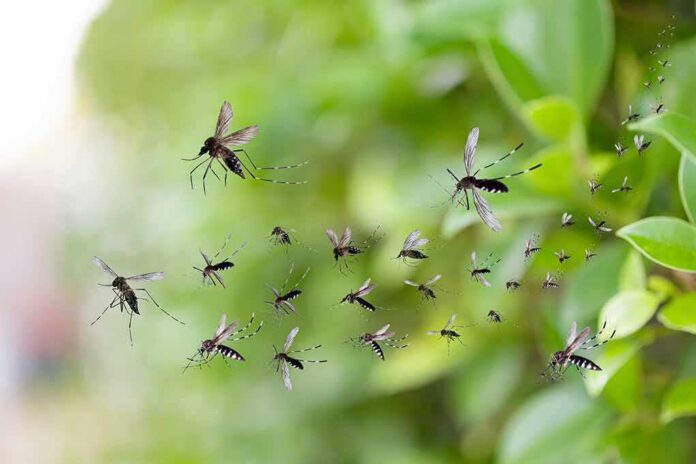
Brazilian neighborhoods seeded with Wolbachia-carrying mosquitoes saw about 69% fewer dengue infections in children—and the effect held even during a major outbreak.
Story Snapshot
- A four-year randomized study in Belo Horizonte linked Wolbachia releases to 69% fewer dengue and chikungunya infections in schoolchildren.
- An earlier study in Niterói found a 69% drop in dengue across treated areas, reinforcing the pattern.
- Wolbachia bacteria block viruses inside Aedes aegypti mosquitoes, shrinking transmission without chemicals.
- Independent reviews find strong, consistent reductions, with a 77% cut seen in Indonesia’s gold-standard trial.
A virus-fighting ally that spreads on its own
Researchers released Aedes aegypti mosquitoes that carry Wolbachia, a common bacteria that lives harmlessly inside many insects. Wolbachia makes it hard for dengue and chikungunya viruses to grow inside the mosquito. When these altered mosquitoes mate, they pass Wolbachia to their young. Over time, more of the local mosquito population carries the bacteria. That shift lowers how many bites can spread disease, without spraying clouds of insecticide or asking families to change daily habits.
The Belo Horizonte study tracked more than 5,000 children across neighborhoods that either received Wolbachia mosquitoes or did not. Children in treated areas had about 69% fewer dengue and chikungunya infections than children in similar untreated areas. Reporters say the cut held during Brazil’s severe 2024 dengue wave, which tested the method under stress. Scientists presented the findings at a major tropical medicine meeting, and Brazilian public health leaders highlighted the results for national planning.
Proof that travels well: from Indonesia to Brazil
Field results in Brazil echo landmark work in Yogyakarta, Indonesia. A cluster-randomized trial there found a 77% reduction in virologically confirmed dengue after Wolbachia took hold. A respected Cochrane review judged the evidence moderate certainty, which is a strong bar in public health. The match between Indonesia’s 77% drop and Brazil’s roughly 69% cut should give health officials confidence. Different cities, different designs, same direction of benefit. That is how methods move from promising to practical.
Niterói, near Rio de Janeiro, provides another anchor point. A quasi-experimental evaluation linked Wolbachia releases with a 69% fall in dengue, with a confidence range that fits the Belo Horizonte results. It also found a sizable drop in chikungunya, pointing to broader gains across viruses carried by the same mosquito. Critics sometimes prefer only randomized trials. Fair enough. But when multiple study types, across countries, converge on the same scale of effect, common sense says the core finding is solid.
Why this works for families and budgets
Wolbachia turns the disease machine off at the source. Households do not need to remember special tablets, stand in long clinic lines, or welcome nightly spray trucks. Once Wolbachia spreads through the local mosquito population, the protection keeps going with minimal upkeep. That kind of “set it and sustain it” design saves money and staff time. Economic reviews suggest that large urban deployments can be cost-saving for society when they prevent hospital stays and missed work at scale.
Mosquitoes Bred to Carry Bacteria Sharply Cut Dengue in Brazil Trial pic.twitter.com/Nac0ZRRjdJ
— NewsPlain (@newsplainapp) November 22, 2026
Public health agencies still need to get the rollouts right. Success depends on reaching enough neighborhoods, keeping releases steady until Wolbachia takes hold, and tracking mosquito infection rates. Cities must keep basic steps like cleaning standing water, because Aedes aegypti thrive in small containers and gutters. But the headline shift is clear. Communities can move from chasing outbreaks to lowering baseline risk, season after season. That is prevention built to last, not panic built to fade.
What this means for a dengue-heavy world
Dengue cases have surged across the tropics as cities grow and weather swings widen mosquito seasons. Vaccines help but face supply and policy limits. Insecticides lose punch as mosquitoes adapt. Wolbachia offers a third path that works with biology, not against it. The Belo Horizonte data, backed by Niterói and Indonesia, gives leaders a practical menu: release Wolbachia mosquitoes, verify spread, keep drains clear, and shave two-thirds off infections in the places that need it most.
Sources:
youtube.com, goodbad.day, aljazeera.com, tandfonline.com, europepmc.org