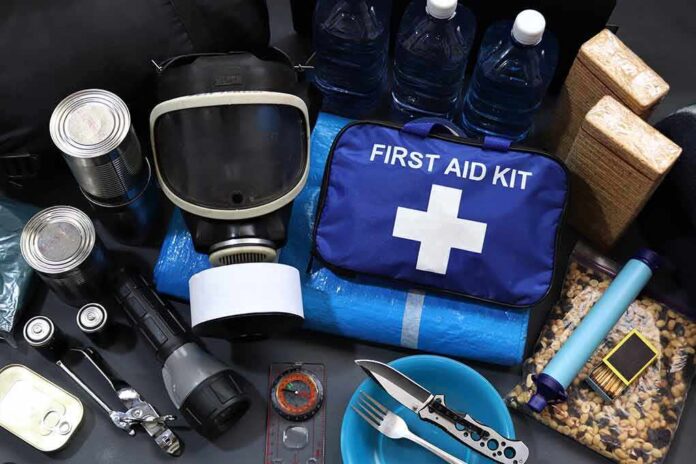
Most American families are one bad storm, one grid failure, or one medical emergency away from discovering their disaster plan consists of a half-dead flashlight and a vague intention to figure it out later.
Quick Take
- Mayo Clinic emergency management coordinator Deb Teske delivers concrete, actionable disaster preparedness guidance covering home, car, and workplace readiness.
- Preparedness is not a one-time checklist event — it is a continuous planning cycle that must be tested, revised, and retested every one to two years.
- Effective preparation includes communication plans, family meeting points, pet planning, disability considerations, and short-term sanitation measures most people never think about until it is too late.
- The same iterative preparedness discipline used inside major hospitals applies directly to how families should think about their own household emergency planning.
Why Most Families Fail Before the Disaster Even Starts
The uncomfortable truth about emergency preparedness is that the gap between knowing you should prepare and actually doing it is enormous. Surveys consistently show that most households lack even a three-day supply of water, a written communication plan, or a designated family meeting point. Deb Teske, a Principal Emergency Management Coordinator at Mayo Clinic in Rochester, has spent her career closing that gap — and her insights apply just as much to a family of four as to a major trauma center. [2]
The reason most families fail is not ignorance — it is the illusion of preparedness. People own a flashlight. They have a general sense that they would “figure it out.” What they lack is a tested system. Teske’s framework, drawn from institutional emergency management, treats preparedness not as a static supply closet but as a living discipline that requires regular activation and revision. [3]
The Planning Cycle That Changes Everything
Mayo Clinic frames emergency management as a continual preparation cycle modeled on the Plan-Do-Study-Act process used in continuous quality improvement. [3] That framing matters enormously for households. It means your emergency plan is not done when you buy bottled water — it is done when you have run through it, found the holes, fixed them, and scheduled the next review. Plans should be activated or exercised every one to two years and then retested whenever circumstances change, such as a new family member, a new home, a new medical need, or a new pet. [3]
This iterative thinking is where most public preparedness campaigns fall short. Government checklists hand you a list of supplies. Teske’s approach hands you a process. The difference between a list and a process is the difference between buying running shoes and actually training for a race. Supplies expire, family situations change, and a plan you wrote three years ago for a different house in a different city is not a plan — it is a false sense of security.
What a Real Household Preparedness Plan Actually Covers
Teske’s guidance for home, car, and workplace preparedness covers territory that standard checklists routinely omit. [4] Communication planning is one of the most overlooked areas — specifically, what happens when cell networks are overwhelmed or unavailable, which is precisely when most disasters occur. Families need a designated out-of-state contact, a written plan that every member can recite without a smartphone, and physical meeting locations rather than digital ones. Writing it down and rehearsing it are not optional steps.
Disability considerations and pet planning are two other areas where preparation gaps become dangerous. Households with members who have mobility limitations, oxygen dependence, or cognitive impairments face a completely different evacuation calculus than the standard advice assumes. Pets complicate shelter options significantly. Short-term sanitation planning — what happens if water service is interrupted for seventy-two hours or longer — is another area that rarely appears in casual preparedness conversations but becomes critical within the first day of a serious disruption. [4]
The Local Relationships Nobody Talks About
One of the most operationally useful recommendations in Teske’s framework is the emphasis on building local relationships before a disaster occurs. [3] Knowing your local emergency managers, fire chiefs, utility personnel, and emergency medical services leaders by name and by role is not bureaucratic box-checking — it is the difference between waiting for information and having a direct line to the people generating it. Mutual aid agreements and cross-training between organizations are the institutional version of what individuals should be doing at the neighborhood level: knowing your neighbors, their capabilities, and their vulnerabilities before you need that information under pressure.
The Cleveland Clinic’s emergency management approach reinforces this point from the hospital side — knowing your surge capacity, your event duration assumptions, and your location-specific vulnerabilities requires the same kind of pre-built relationship network that Teske describes. [1] The parallel is instructive. Hospitals that wait until a crisis to figure out their capacity are the hospitals that fail their patients. Families that wait until a crisis to figure out their plan are the families that end up depending on strangers for survival. Preparation is not pessimism. It is the most rational investment a household can make.
Sources:
[1] YouTube – Disaster Preparedness: What You Need | Mayo Clinic Health Matters …
[2] Web – Emergency Management: Being Prepared During a Crisis (Podcast)
[3] Web – Are You Prepared for the Next Disaster? – Apple Podcasts
[4] Web – A look at emergency preparedness and how to make it happen